
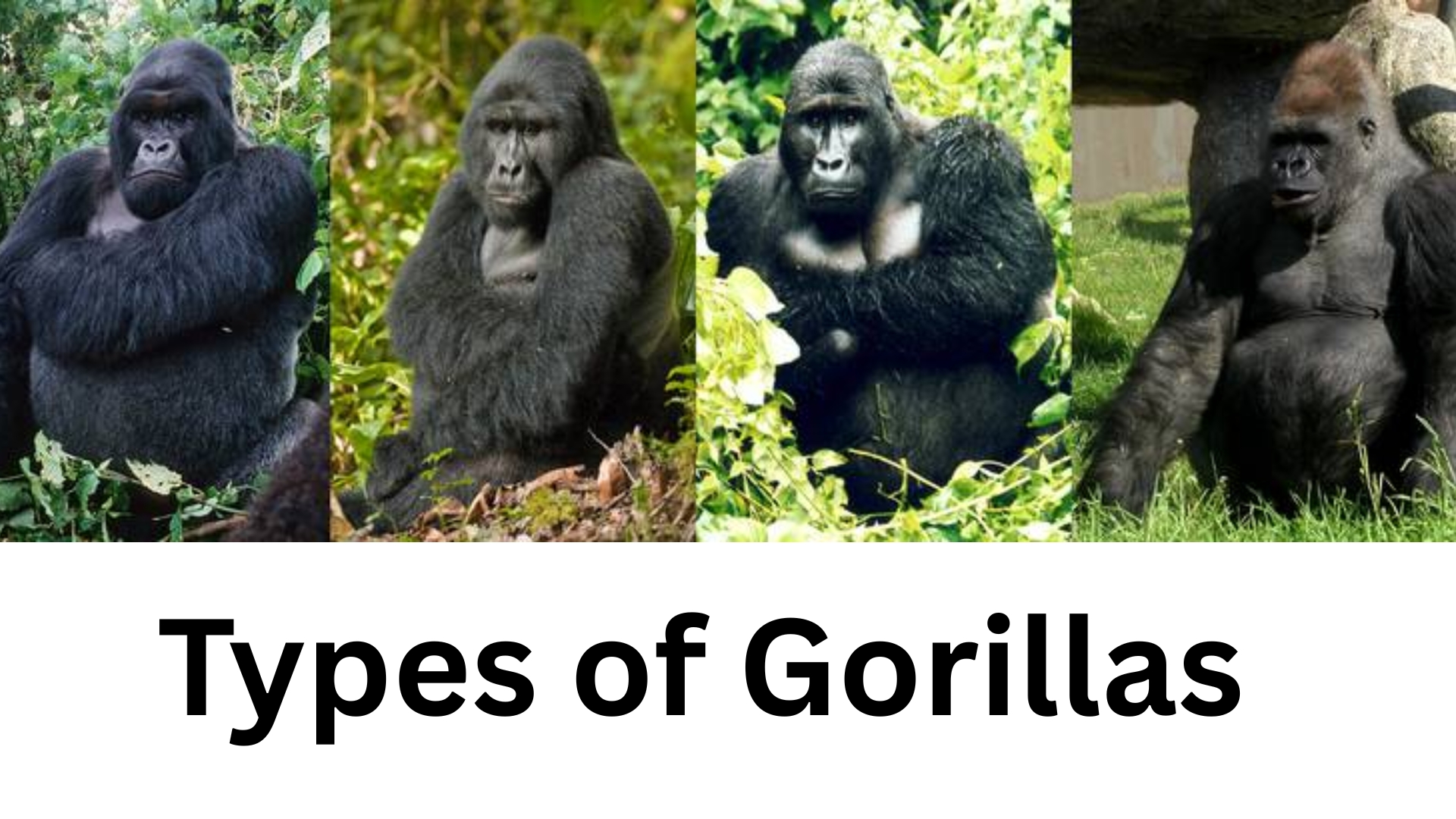
Types of Gorillas
Did you realize that we are close to 98 percent DNA with gorillas? These are soft giants who win our hearts. They show deep emotions. They live in polygamous families. However, the fact that they are diverse is unknown to many. You can imagine a gorilla in a foggy mountain. Or perhaps you will find one in a thick swamp. Both images are correct. Two species are distinguished among gorillas by scientists. They also subdivided them into four subspecies. Each type has a unique story. Both of them have particular difficulties.
This guide deals with the Types of Gorillas. We will look at their homes. We will examine their habits. And, we will know how they struggle to survive. Let’s meet our close cousins.
The Two Main Species
Taxonomy can seem confusing. Let’s keep it simple. Two major species are known to the scientific world.
- The Western Gorilla (Gorilla gorilla)
- Gorilla beringei (Eastern Gorilla).
Geography separates them. Between them is approximately 560 miles of heavy Congo Basin forest. They never meet in the wild. This division led to their divergences.
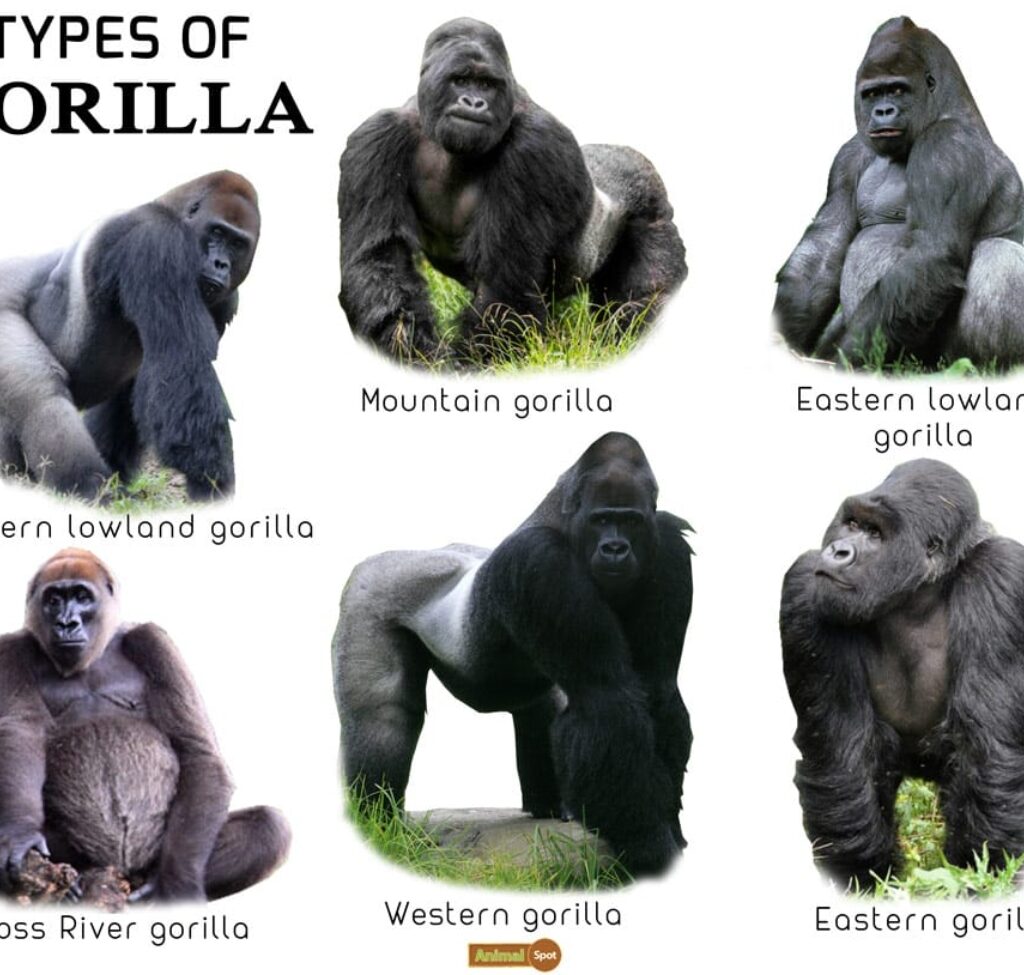
The Western Gorilla (Gorilla gorilla)
The more numerous one is the Western Gorilla. They are the inhabitants of West Central Africa. They will be found in such countries as Cameroon, Gabon, and the Republic of Congo. This species is split into two subspecies.
Western Lowland Gorilla
This is one of the gorillas that you probably find in zoos. They are the most common type.
Physical Characteristics
They form the smallest subspecies. Yet, they are still powerful. Adult men have a weight between 300 and 400 pounds. They possess black-brown hair, which is short. Male elders acquire a silver saddle on the back. We call them “silverbacks.” They have wide skulls compared to their eastern counterparts. Their brow ridges are also deep.
Habitat
They love dense rainforests. Isolated swamps are also their habitat. You will see them in the lower altitudes. These live in the damp, wet forests of Central Africa.
Diet
These apes love fruit. A big portion of their diet is fruit. They go a long distance in search of the fruits of the season. The leaves, stems, and bark are consumed when fruit is not available. They are also insect feeder, such as termites.
Behavior
The Western Lowland gorillas are found in smaller groups. An average team consists of 4-8 people. They are generally peaceful. Nevertheless, the males will engage in a fight to defend their families. They are unique in that they are a little more arboreal (tree-dwelling) than mountain gorillas.
Conservation Status
They are Critically Endangered by the IUCN. Poaching hits them hard. The destruction of habitat kills their habitat. The Ebola virus has also swept through large populations. The population has reduced by over 60 percent in the last few decades.
Cross River Gorilla
It is the most elusive of the great apes in Africa. They are elusive. Few people ever see them.
Physical Characteristics
They resemble the western Lowland gorillas. There are subtle variations in the shape of the skull and teeth. They are slightly smaller. Their legs and feet are also smaller.
Habitat
They dwell in an extremely narrow locality. They occur only on the border between Nigeria and Cameroon. Therefore, they live in hilly terrain forests. They remain high in an attempt to evade human beings.
Diet
They live on the same diet as the Western Lowland gorilla. They feed on fruit, leaves, and herbs. The food restrictions are because of their habitat.
Behavior
We know less about them. They are wary of humans. Decades of hunting have been put on them. This makes them hide. They can even toss sticks or a bunch of grass in defence.
Conservation Status
They are on the brink of death. There are fewer than 300 survivors. Their forest is fragmented. They inhabit small, remote communities. This complicates the breeding. Conservationists are also trying their best to connect their forests.
The Eastern Gorilla (Gorilla beringei)
We have come to East Central Africa. The Eastern Gorilla is bigger. They have darker, longer fur. Their habitat is Uganda, Rwanda, and the Democratic Republic of Congo (DRC).
Mountain Gorilla
These are the movie stars. You could remember them in Gorillas in the Mist.
Physical Characteristics
They are built for the cold. They live at high altitudes. Their fur is thick and long. It warms them when they are in freezing conditions. They tend to be bigger as compared to western gorillas. Males weigh up to 485 pounds. Their arms are short in proportion to their bodies.
Habitat
They live on volcanoes. In particular, the Virunga Mountains. They live in bamboo areas and cloud forests. Altitudes range from 8,000 to 13,000 feet. The air is thin there.
Diet
Fruit is scarce high up. Mountain gorillas are mostly folivores. They chew on leaves, stems, and shoots. Popular ones include celery and bamboo. Most of their time is devoted to eating. Their bodies require huge quantities of greens.
Behavior
They are very social. Group sizes can be large. Some contain more than 30 people. They are generally gentle. They bond through grooming. Silverbacks are fierce defenders of the group.
Conservation Status
They are Endangered. This is actually good news. At some time, they were Critically Endangered. Hard conservation efforts were of assistance. Populations are rising. It currently has more than 1,000 people. It is a hard-to-find conservation success story.
Grauer Lowland Gorilla (Eastern Lowland Gorilla)
This is the king of the family. It is the most giant primate on the planet.
Physical Characteristics
They are stocky and robust. Males can weigh over 500 pounds. These are shorter in the muzzle as compared to others. Their hands are massive. Their coat is jet black. Similar to others, males become silver with age.
Habitat
They live only in the DRC. They are found in tropical rainforests. Their range has shrunk. They once roamed a vast area. They are now dwelling in little patches of wood.
Diet
Their diet is diverse. When at hand, they consume fruit. They also invest much in herbaceous plants. They possess powerful jaws that are used to break hard plants.
Behavior
They are semi-nomadic. They travel to find food. Therefore, they normally have one strong male in their groups. They also build nests in order to sleep like other gorillas.
Conservation Status
They have been Critically Endangered. The civil unrest in the DRC is detrimental to it. Illegal mining destroys. One of the biggest threats is poaching bushmeat. Scientists predict the number to be less than 4,000. Their population is ever-decreasing.
Key Differences at a Glance
It helps to compare them side-by-side.
- Fur: Mountain gorillas are the hairiest. The hair on Western Lowland gorillas is short and brownish-gray.
- Size Eastern Lowland gorillas revert to being the heaviest. The lightest gorillas are Western Lowland.
- Location: Western species are found in West Central Africa. Eastern species inhabit East Central Africa.
- Diet: Western gorillas consume more fruit. Gorillas in the mountains consume bigger amounts of leaves.
The Threats They Face
Gorillas are strong. But they are vulnerable. Their problems are mostly caused by human beings.
Habitat Destruction
Forests are disappearing. Timber-burning firms deforest. Farmers clear land for crops. Gorillas need space. In case forests become smaller, gorillas have no place to run.
Poaching
This is a grim reality. Human beings hunt gorillas. We refer to it as the bushmeat trade. It is illegal. Yet, it continues. Gorillas are also caught in snares that are used to trap other animals. These are pitfalls that result in injuries or even death.
Disease
We are closely related. This means we share germs. Gorillas are killed by human diseases. They can be killed by a mere flu. Ebola has been catastrophic. It exterminated a third of the wild gorilla population at the beginning of the 2000s.
Civil Unrest
War impacts wildlife. Armies hide in forests. Refugees run away to safe regions. This interferes with the habitats of gorillas. It renders the conservation effort risky.
Why Conservation Matters
By saving gorillas, forests get saved. They are forest gardeners. Thus, they consume large quantities of fruits. They deposit seeds in their excrement. This helps trees grow. Carbon is taken up in healthy forests. This fights climate change. This is also helpful to the local communities. Gorilla tourism is a source of finances. It creates jobs. It builds schools. When individuals gain out of the gorillas, they guard them.
Conclusion
We look into a gorilla’s eyes. We see something familiar. However, we see intelligence. We see family bonds. We are reflecting on ourselves. The situation with saving the gorilla is not simply biological. It has to do with keeping a part of our own history. It is only we who can destroy them. We also happen to be the species that can save them. It is up to us to live or die.
The Mountain Gorilla is recovering, which means that there is hope. We can reverse the damage. We can protect their forests. Thus, we will be able to make sure that the future generations hear the chest-beat of the silverback in the wild. The time to act is now. We will be their good watchmen.